
Overview
SMU media operations needed a clearer picture of storage use across years of photo and video work. The analysis combined directory scans with job and negative-number records, calculated folder sizes, segmented activity by fiscal year, and documented where the source data could not fully reconcile.
Problem
Media data was spread across central storage, external drives, Box, FileMaker records, and folders that did not always follow a consistent job-number convention. Manual inspection could not provide a dependable view of total use, unprocessed material, or future demand.
Context & role
I developed the scripts and analysis while supporting SMU's Photo/Video Department as a contractor. Proprietary source datasets were excluded from the public repository; only scripts, sanitized screenshots, and the summary report are published.
Approach & workflow
- Scan directories. Traverse included volumes and record file paths, counts, extensions, and folder sizes.
- Normalize identifiers. Extract and check job and negative numbers embedded in folder names.
- Integrate records. Match scan output with exported operational records where possible.
- Segment and summarize. Compare storage by fiscal year, media type, and project grouping.
- Report uncertainty. Document inaccessible locations, unmatched records, duplicate risk, and confidence limits.
Tools & technologies
Data & inputs
The working dataset included job numbers, negative numbers, file paths, folder sizes, fiscal years, and selected FileMaker exports. The published report explicitly notes that some hard drives and Box-only material were not included, so the analysis should not be read as a perfect inventory.
Results
Decision-support outcome
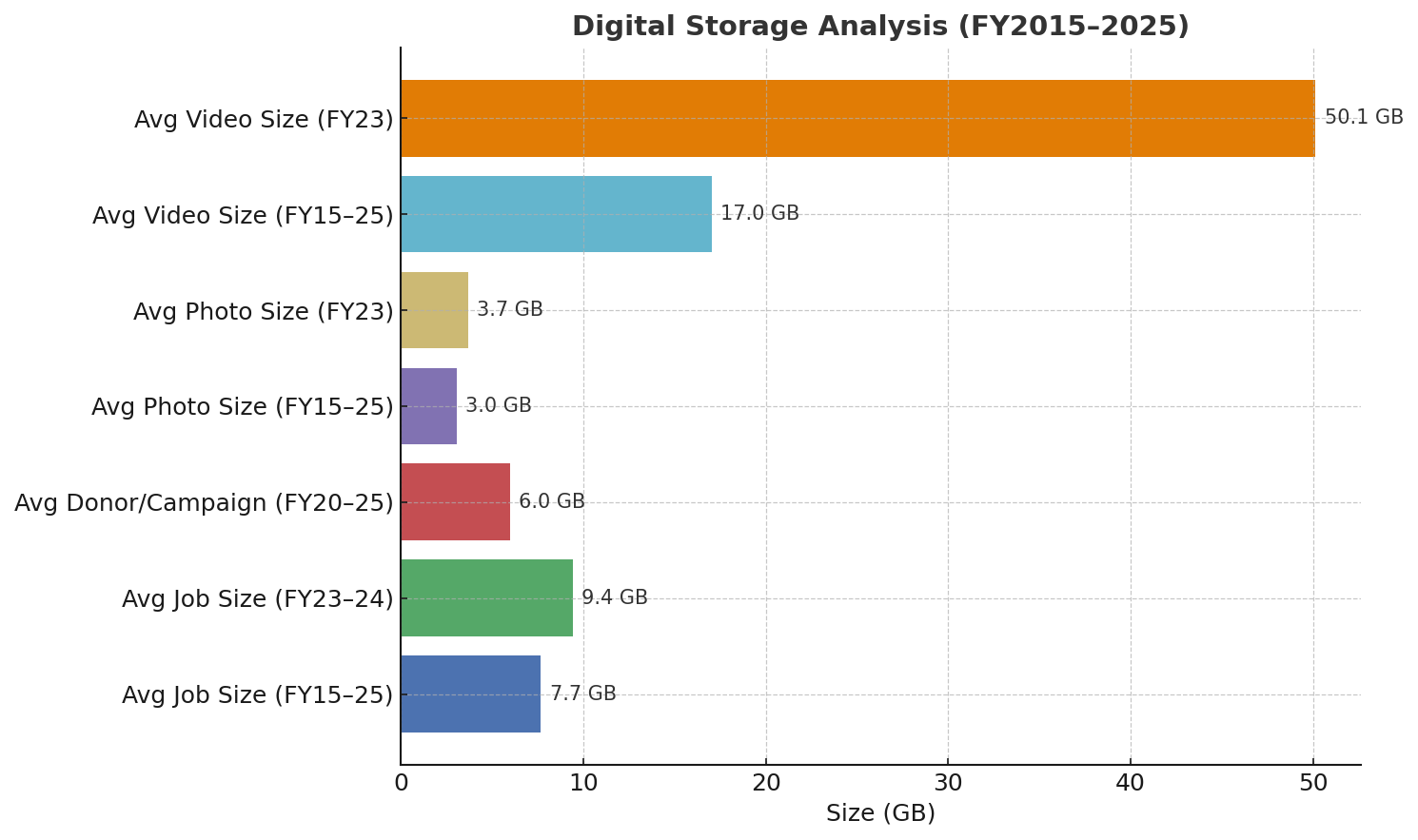
The scan identified 302,933 folders in the central media directory and helped quantify more than 120 TB across reviewed storage locations. The findings supported the reasonableness of a 10-14 TB annual storage-planning estimate while distinguishing long-term backlog from yearly growth.
Technical challenges
- Folder names and operational records did not always use the same identifiers.
- Pending, duplicate, temporary, and externally stored files complicated reconciliation.
- Decimal and binary storage units needed clear labeling to prevent misleading comparisons.
- Large directory scans required structured output that could be checked outside the script.
Limitations
The source report assigns moderate confidence to the dataset because some locations were inaccessible and many FileMaker records did not match scanned directories. Findings support planning and investigation, not a claim of complete enterprise inventory accuracy.
Future improvements
- Add repeatable logging and incremental scans.
- Create a documented matching strategy for unresolved job identifiers.
- Track storage trends over time with a lightweight dashboard.
- Separate active work, preservation copies, derivatives, and redundant files.